Digital lean

We build IT solutions for companies that have outgrown
off-the-shelf systems
.

Platforms are built around a company's internal processes, taking into account its business logic, data and employees' tasks. Your business systems stay in place.

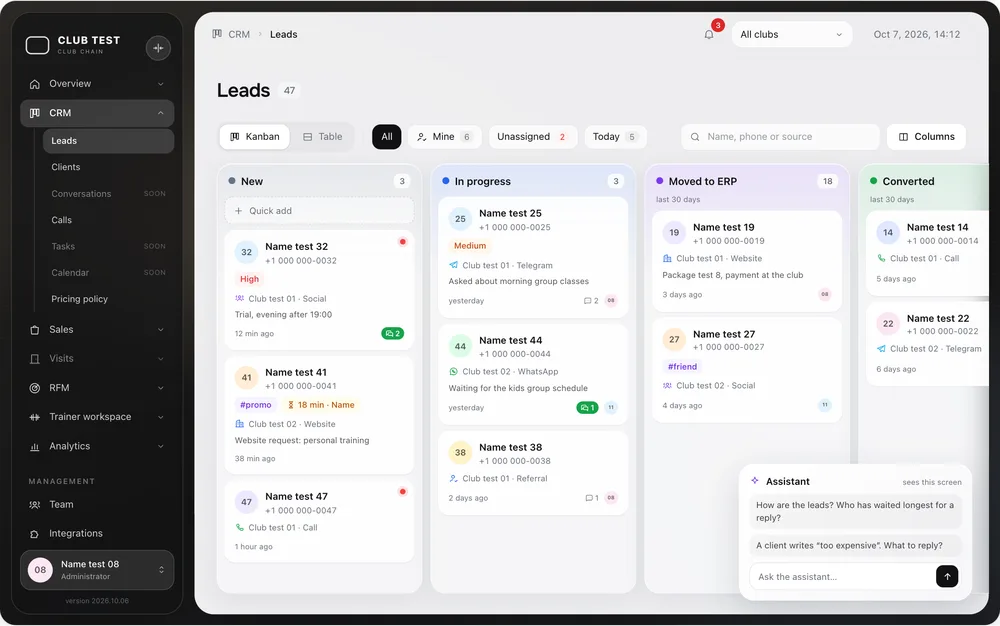
Workspace example · Client management
  • Overview
  • CRM
    • Leads
    • Clients
    • Conversationssoon
    • Calls
    • Pricing policy
  • Sales
  • Visits
  • RFM
  • Specialists
  • Analytics
Management
  • Team
  • Integrations
  • Settings
08
Name test 08Administrator
Leads7
KanbanTableAllMine 2Unassigned 1Today 0Name, phone or source
New2
+ Quick add
In progress1
Moved to ERP3
last 30 days
Converted0
last 30 days
Drop here
Archive1
last 30 days
31
Name test 31+1 000 000-0031

Phone, direct call

Sep 2508
32
Name test 32+1 000 000-0032

Social, direct messages

Oct 608
33
Name test 33+1 000 000-0033

Website, booking form

Sep 2508
34
Name test 34+1 000 000-0034

Telegram, direct messages

Service test 01, group

Sep 29108
35
Name test 35+1 000 000-0035

Telegram, direct messages

Service test 02, personal

Sep 29108
36
Name test 36+1 000 000-0036

Social, direct messages

Service test 02, personal

Sep 29108
37
Name test 37+1 000 000-0037

Phone, direct call

Sep 2608
Next step

Name test 32 wrote on social media 40 minutes ago; no one has taken the lead yet.

The employee decides

What we do

We develop custom IT solutions designed strictly around the requirements and architecture of your business model

  1. FIG 0.1
    Process decompositionBefore development starts, we run an “as is” audit of operations. We trace the actual route: where data originates, who makes decisions and what those decisions actually rest on.
  2. FIG 0.2
    Core system extension or a new platformWe match the architecture to the scale of the task. If the current system of record is stable, we deploy an operations layer on top of it. If off-the-shelf software has become the bottleneck, we design an independent platform from scratch around your business logic.
  3. FIG 0.3
    Role-based employee focusThe platform does not replace the team's expertise; it directs the team's attention. The workspace cuts out information noise and shortens the path from receiving data to the intended action.

When it is needed

When standard tools are no longer enough

Systems keep the records, but employees still gather data, coordinate actions and hand over tasks by hand.

  1. 01Fragmented IT landscapeThe client is recorded in the CRM, the payment is posted in the ERP, the conversation runs in a messaging app, and before a call the employee opens three windows.
  2. 02Complex routingThe sales manager hands the order to the warehouse, and the warehouse hands it to delivery. At every handoff, the next action has to be agreed.
  3. 03Limits to scalingWhen a new location opens, a way of working that relied on one experienced administrator can no longer carry the load.

As the business grows, manual coordination becomes a source of losses

  • TimeInformation has to be gathered from several sources before the operation can be carried out.
  • ErrorsA decision may be made without part of the necessary context or on the basis of outdated data.
  • Missed resultsAn opportunity to increase revenue, reduce inventory or prevent a deviation may be discovered too late.

What the business gets

Instead of manual micromanagement, a work environment where data is structured around specific tasks, your procedures are followed, an algorithm highlights risks and missed opportunities.

  1. For the company

    Tasks are ordered by the company's rules and values

    The company itself defines what matters to it: client value, reply deadline, risk of leaving, deal amount. By these rules, clients and tasks are grouped and prioritized every day. The data comes from the company's business systems, and the systems themselves keep working as before.

  2. For the manager

    Priorities and gaps are visible during the day

    The manager sees which important tasks are still not done, where leads wait past their deadline and how long they take to process. If the priority rules are changed, employees' lists are rebuilt at once, with no exports or reports.

  3. For the employee

    The day's list is already sorted by importance

    The employee sees who to work with first and why: every task has a reason and a next step. Client data is already loaded, the deal stage does not have to be marked by hand, and getting started takes no lengthy training.

This description is based on feedback from an employee who works every day in the workspace of the “Client management” project.

Solutions

Where time is lost in your business area and what each role sees

How work changes in practice

01

Imported goods trading

Warehouse: receiving and putaway

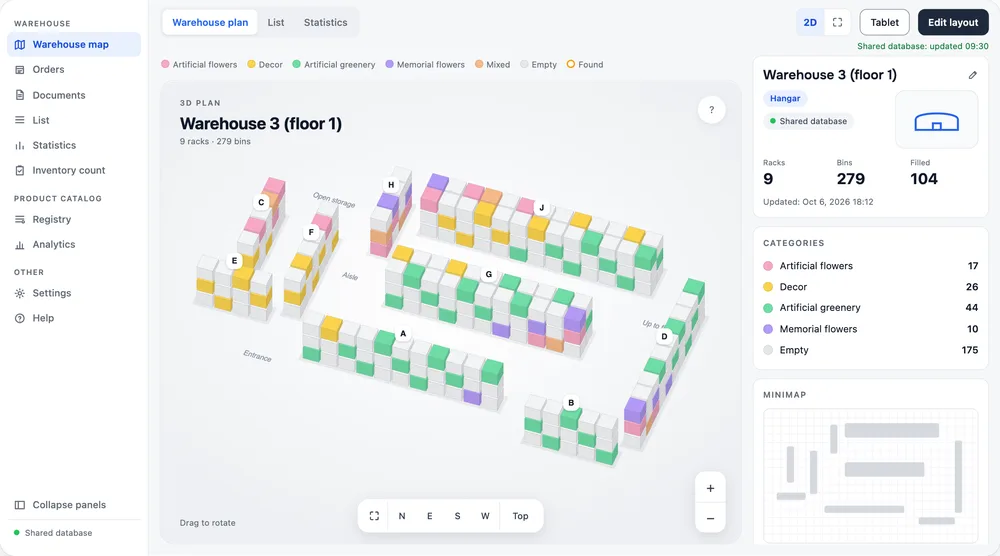
  1. 01Physical spaceWarehouse racks, shelves and bins
  2. 02Digital modelEvery bin and how often each product is handled
  3. 03Employee's operationThe route to the right bin, in the task
    Ticket test 118Rack A2, shelf 2
Open project
Business goal
Ensure fast and accurate order picking while reducing dependence on key employees (shorter time-to-productivity for new hires).
Bottleneck
The system saw stock but not the warehouse layout. Routing depended on the personal experience of warehouse workers.
Solution
A workspace for the warehouse employee was built on a 3D plan. At receiving, each product gets an assigned bin, orders from the CRM become work orders with bins on the plan, and warehouse documents update stock.
Key metrics
Order picking time, mis-pick rate, share of products with an exact bin location. Figures are published once the client approves them.
02

Membership club chain

Client management

Client card
Name test 03Regular client, membership

Queue reasonMissed two of their usual intervals between visits

CallOffer a bookingHand to a specialistPostponeLeave alone
Open project
Business goal
Proactive management of LTV (the client lifecycle) and minimizing membership churn.
Bottleneck
The CRM recorded only what had already happened. A drop in visit frequency was noticed too late.
Solution
An administrator interface with a trigger system was built. Deviations from the visit schedule automatically form a queue of retention tasks with ready-made reactivation scenarios.
Key metrics
Completeness of visit history, time from entering the queue to action, additional clients brought back net of costs. Figures are published once the client approves them.
03

Other projects

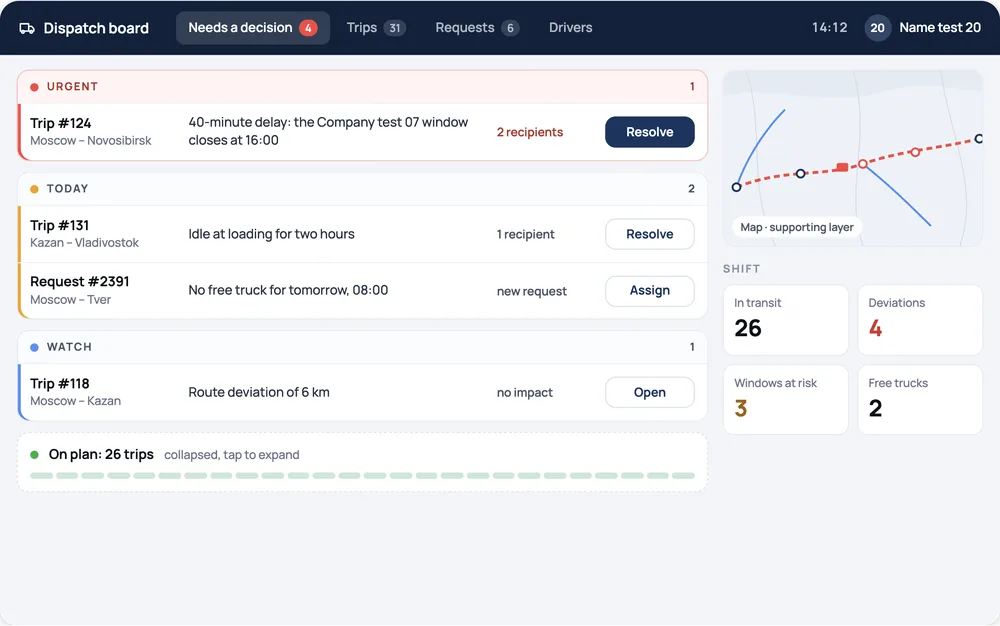
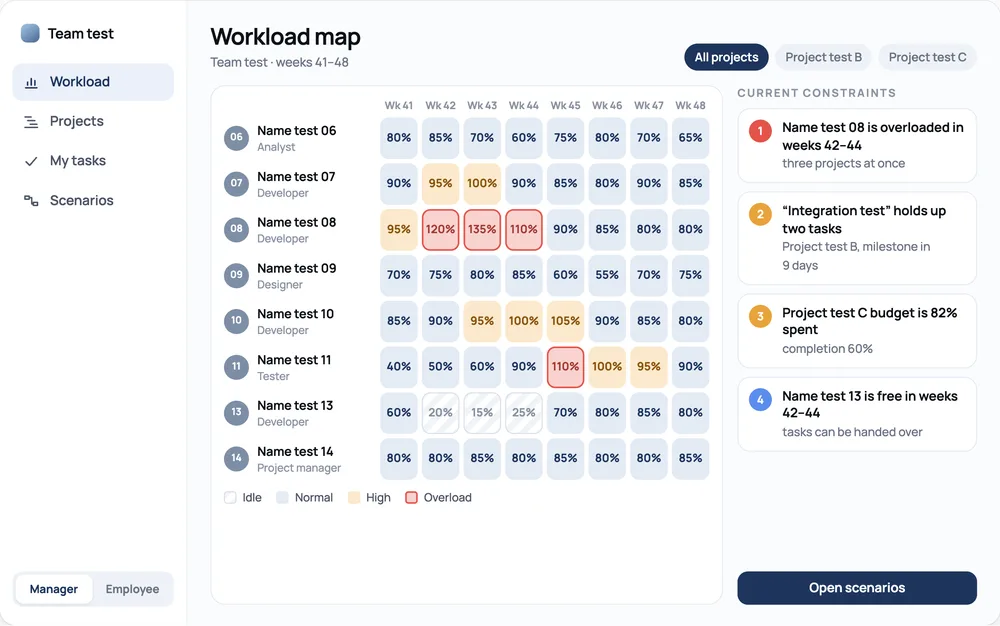
Logistics, project team workload and the owner's summary are on the projects page. Tasks from other business areas are examined in an audit.

All projects
  • Chains and branchesHow can you see how each location works and notice deviations without constant calls?Discuss your task
  • Inquiries and requestsHow can you stop losing inquiries from messaging apps, the website and calls, and see who is responsible for them?Discuss your task
  • Approvals and documentsHow can you get a contract or invoice approved without email and chats, and see who it is waiting on?Discuss your task
  • Service and repairHow can you take an order from inquiry to completion with less waiting and less rework?Discuss your task
  • Numbers for the ownerHow can you get an operation's metrics without assembling spreadsheets by hand at month-end?Discuss your task
  • New employeesHow can you bring a new hire up to speed when the way of working lives in the heads of experienced staff?Discuss your task

How to start

First the target model of work is defined, then it is moved into a digital environment

How the work goes

How we build the architecture of your processes

  1. 01Architectural design of the business logicWe study the company's individual characteristics on two levels: the strategic goals of the business and the daily operating routine of its staff. We form a conceptual and logical model of the future platform, in which every process has a strict rationale.
  2. 02Designing the target data modelWe define the structure of the platform. We design secure gateways for data exchange between the new platform and your business systems. The infrastructure is laid out to rule out data loss and duplicate systems.
  3. 03Custom development of the role-based platformWe program the logic of the operations and create specialized workspaces. Interfaces are developed strictly for the tasks of specific employees: they cut out unneeded functions and keep the team's attention solely on the actions that matter.
  4. 04Platform integration and scalingWe deploy the platform on the company's real processes. The platform takes over management of the operational load, makes metrics transparent for managers and opens the way to growing several times over without breaking the current infrastructure.

The principle, shown on one order

The principlenow

We do not digitize chaos.

Before development starts, we remove redundant actions and idle time.

Only the streamlined, faster process moves into the digital workflow.

Metrics and money

The company's money breaks down into the metrics of each role

Revenue, margin and working capital are made up of metrics that specific employees manage. The audit picks a metric, the workspace shows it to the role every day, and after launch the same metrics are compared with the baseline.

Financial lineRevenue

Revenue = active clients × purchase frequency × average ticket − discounts and promos

CalculationInquiries × conversion to first purchase

Metrics
  • Inquiries by channel
  • Time to first reply
  • Conversion by pipeline stage
  • Client acquisition cost (CAC)
  • Share of lost leads
Methods and levers
  • Lead assignment and reply deadline
  • First-contact scenario
  • Comparing channels by cost per client, not per lead

What the workspace showsThe sales manager sees unanswered leads, their deadline and source; the manager sees where the pipeline loses clients. Open project

Client segments: the same metrics are read for each one
  • Newfirst purchase in the last 30 days
  • Activebuy at their usual rhythm
  • About to leavea gap 1.5 times longer than usual
  • Dormantno purchases for more than three usual intervals
  • High-valuetop 20% by spend over the year
  • Promo-onlybuy only at a discount

An operation audit ends with one of three decisions

An audit of one operation takes an estimated 1–2 weeks. The process, data and constraints are examined, the effect and costs are assessed, and the cost of the audit is credited if development follows.

  1. 01ResearchThe business, process, data and constraints.
  2. 02AssessmentThe possible effect and the cost of changes.

Decision options after the audit

  • ReengineeringOptimizing procedures and the way of working, with no new software.
  • AdaptationConfiguring your current systems or integrating ready-made modules.
  • Custom developmentDesigning your own system if the expected economic effect exceeds the costs.

Questions

What people usually ask before the work starts

  1. Do systems that already work need to be replaced?No, if the system does its job. The platform takes the data it needs from it, and the records stay where they are kept today.
  2. What if no new software is needed?Then the audit ends with a recommendation that involves no development: change the way of working or configure what is already there.
  3. How long does the work take?An audit of one operation takes an estimated 1–2 weeks, and the first workspace for one operation takes 4–8 weeks. The exact timeline is given after the audit.
  4. How much does the audit cost?The audit is paid, and its cost is credited if development follows. The audit plan with its timeline and cost arrives after the first conversation.
  5. Who owns the data and the platform?The data and the solution stay with the company, along with the operation passport. The terms for exiting the project are set out in the contract.
  6. Can the work start with one operation?The work always starts with one operation. The next operation becomes a separate project once the first has shown a result.

Let's discuss what is slowing the work down

Send a request. We will get in touch for a short briefing to discuss the problem operation and the current IT landscape and to define the audit format.

A reply comes within response time. The first conversation is short: which operation, what has already been tried, who makes the decision and whether an audit is needed. An audit of one operation ends with a recommendation, and one of the options involves no new software.

Request an operation audit

First it is established how the operation actually works, and only then is it defined how it should work.

Which operation worries you most?

The reply comes where it suits you